
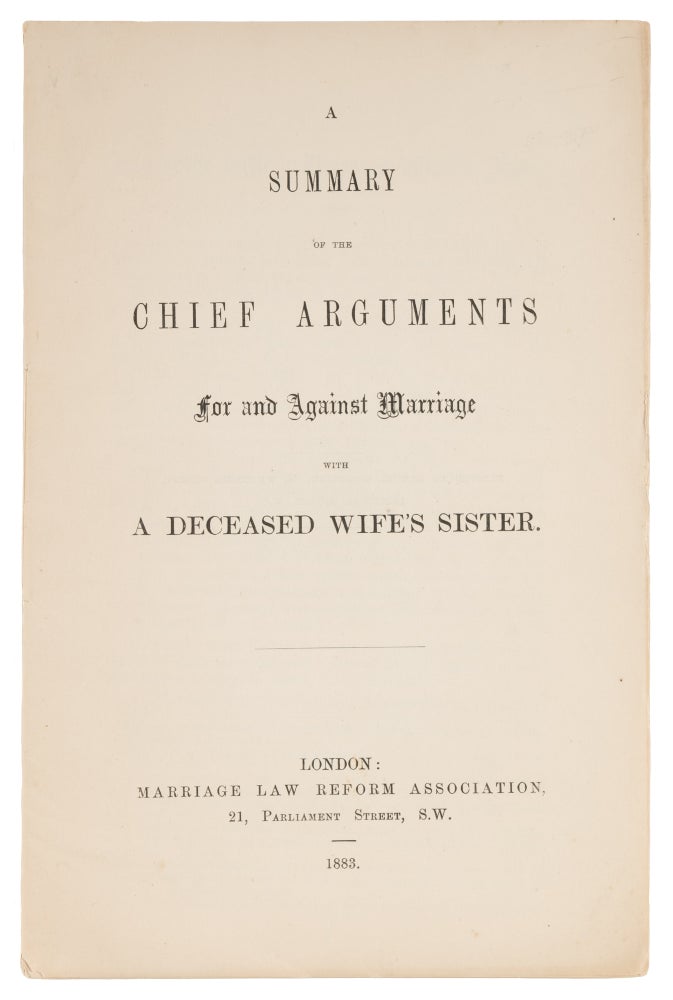
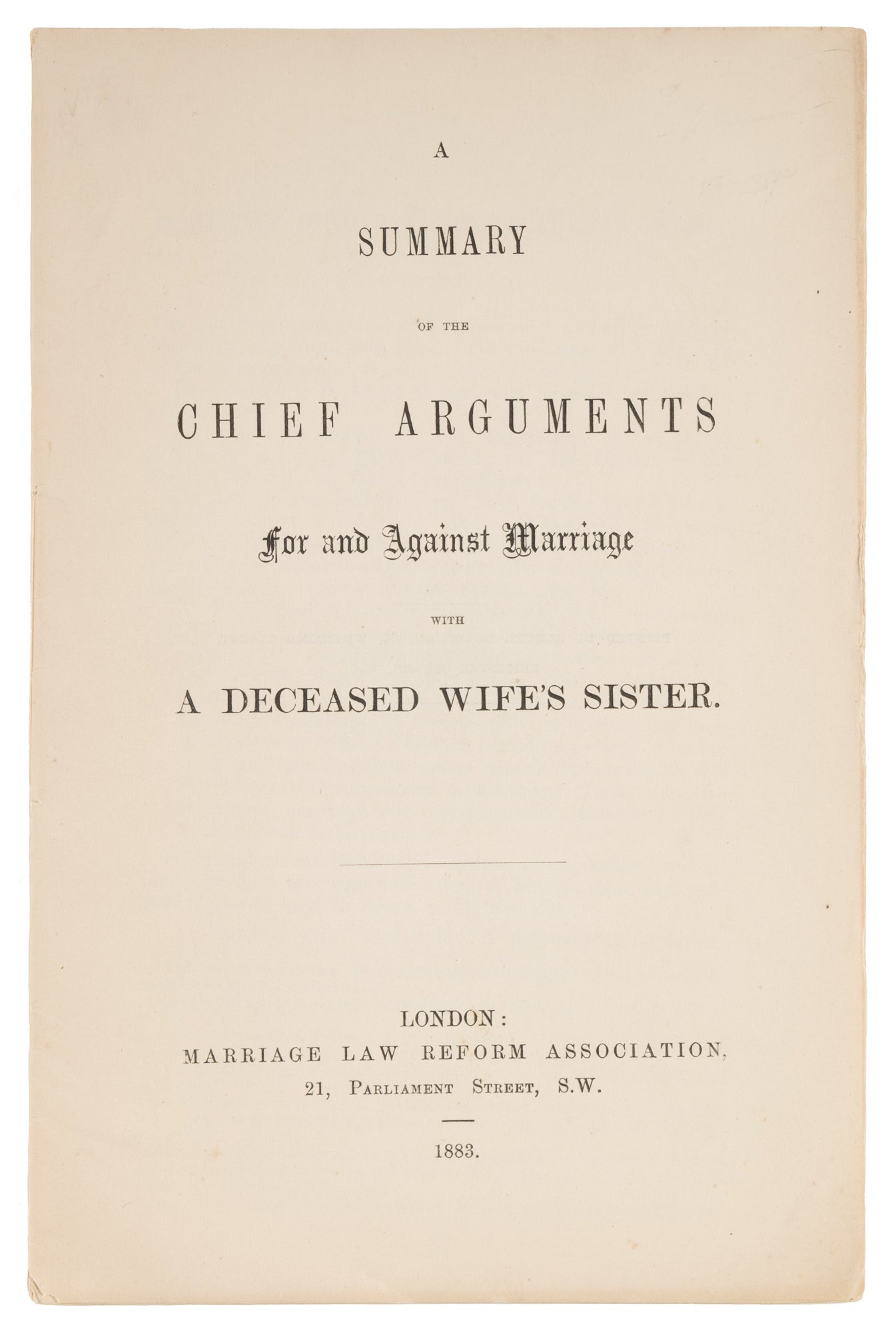
A Summary of the Chief Arguments For and Against Marriage With A...
The "Annual Blister" of Victorian Law: A Scarce 1883 Reformist Tract on the Deceased Wife's Sister Controversy Marriage Law Reform Association. A Summary of the Chief Arguments For and Against Marriage With A Deceased Wife's Sister. London: Marriage Law Reform Association, 1883. 15, [1] pp. Octavo (8-1/4" x 5-1/2"). Stab-stitched pamphlet in self wrappers. Light toning, negligible edgewear, light foxing in a few places. $350. * Third and final edition. A scarce reformist tract representing one of the most protracted legal and social battles of the Victorian era. The Marriage Law Reform Association was established in 1851 to overturn Lord Lyndhurst's Marriage Act of 1835, which codified the prohibition of marriage between a widower and his sister-in-law. This restriction was rooted in the theological "one flesh" doctrine of affinity, which legally equated a wife's sister with a blood sister. The controversy, often dubbed the "annual blister" due to its near-yearly debate in Parliament, highlighted a sharp class divide; while the wealthy could travel abroad to marry, the working classes-who relied on sisters-in-law for domestic stability-were forced into "legalized concubinage." The debate permeated Victorian culture, appearing in works ranging from Gilbert and Sullivan's Iolanthe to the novels of Dinah Craik. This edition captures the height of the Association's campaign, which eventually succeeded with the passage of the Deceased Wife's Sister's Marriage Act in 1907. Sweet & Maxwell, A Legal Bibliography of the British Commonwealth of Nations, Vol. 2, p. 224.
Price: $350.00
Book number 72729